Serious Games and Simulations: Generative AI Reshuffles the Deck
Generative NPCs, adaptive difficulty, virtual labs: AI transforms game- and simulation-based learning, with promising results and concrete limits.
Generative NPCs, adaptive difficulty, virtual labs: AI transforms game- and simulation-based learning, with promising results and concrete limits.
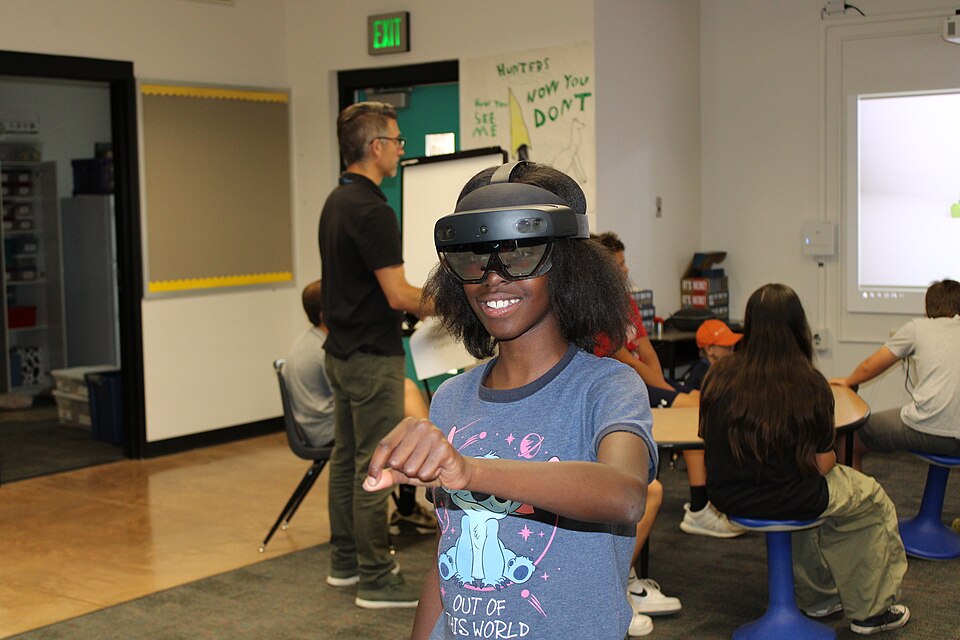
Serious games and simulations rest on a powerful idea: we learn by doing, trying, failing without real consequence. For a long time these environments were costly to build and rigid — pre-written scenarios. Generative AI changes that: characters that converse freely, difficulty that adjusts, worlds that react.
The most visible change concerns LLM-driven NPCs (non-player characters). A serious game on digital literacy, whose NPCs were guided by a credibility-evaluation framework, produced larger skill gains against misinformation and higher engagement than traditional instruction [1]. In orientation, generative NPCs in virtual reality let international students rehearse language and administrative tasks with less anxiety and very high completion rates [4].
A systematic review of 55 studies (2021-2026) synthesises the mechanisms of AI-supported game-based learning — adaptive difficulty, LLM scaffolding, intelligent NPCs, stealth assessment — and their outcomes, challenges and blind spots [2]. Cognitively, combining visual demonstrations with conversational verbal support lowers cognitive load relative to text-only help [3]. 'AI-native' games manage to convey complex concepts, for example in ethnography, to non-specialists [5].
AI is not only for playing: it lowers the cost of creation. Using natural language as the design interface lets non-expert teachers retain control while aligning pedagogical goals with game mechanics [6]. Work maps where generative AI accelerates each stage of the development lifecycle — assets, narrative, code [8]. And beyond cognition, a generative narrative game significantly reduced student stress in a controlled pilot trial [7].
A good serious game does not entertain at the expense of learning: it makes effort desirable by putting it in context.
Learnya synthesis
Generative simulations suit skills that are practised — languages, relationships, decision-making, safety. As always, their value depends on pedagogical design, quality control of generated content and data governance that respects learners.
The recurring risk of educational games is dissonance: a playful skin laid over content the player can complete without learning anything. Generative AI does not remove this risk, it shifts it. A chatty, credible NPC can give the illusion of a rich experience while leaving the pedagogical goal aside. The field's systematic review stresses this: mechanics must be aligned with the intended learning, and evaluated as such [2].
Generative simulations excel above all for skills practised in situation: conducting an interview, handling a crisis, speaking a foreign language, deciding under constraint. Being able to replay without real consequence, with a partner that adapts, is a major pedagogical asset — provided the feedback is accurate. Here too, design comes first: constrain NPC behaviour, define explicit success criteria, plan a debrief.
Concrete constraints remain. Latency, still high in some immersive setups [4], breaks immersion; compute cost limits scaling; and generated content must be checked to avoid errors and bias. Not to mention data: an immersive environment can capture voice, movement and choices, all sensitive information to govern carefully. Well designed, generative serious games make effort desirable; poorly framed, they entertain without instructing.
The most solid promise of generative simulations concerns skills not learned from books: conducting a difficult dialogue, reacting to an unforeseen situation, speaking a language with ease. These require repeated practice, a partner that adapts and a right to fail — three things AI can now offer at lower cost.
For this promise to materialise, design must stay in charge: aligning mechanics and goals, controlling the quality of generated content, planning a debrief that turns experience into conscious learning. Expected progress on latency and compute cost will make these environments smoother. But it is always pedagogy, not technical prowess, that decides whether the game instructs or distracts.
One underused strength deserves mention: stealth assessment. Because a simulation records what the learner does, not just what they answer, it can measure competencies that traditional tests miss — persistence, strategy, collaboration — without interrupting the experience. Well designed, this gives teachers rich evidence of learning and gives learners feedback that feels like part of the game rather than an exam. Here again, the value comes from aligning the measurement with genuine learning goals and governing the behavioural data responsibly.